

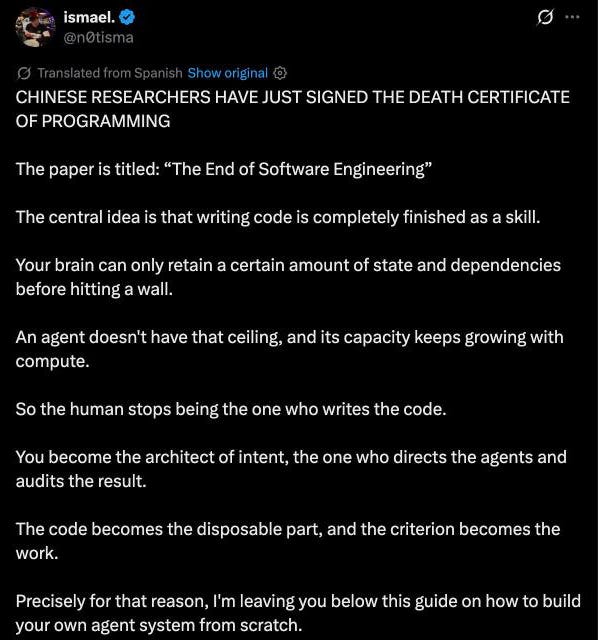
This tweet came across my feed this morning. Chinese researchers, it says, have just signed programming’s death certificate, in a paper called “The End of Software Engineering”. Hundreds of thousands of views.
You’d think I’d be cheering. Two pieces ago I wrote The 50-year storm is here. Are you surfing yet?, and I said the SDLC is going to thin out until it has evaporated. Then in Fast or good was never a law, I said the fight at Proton was the storm happening in real time, and that fast without gates is just fast.
So I read the paper. It does tie those two pieces together, just not the way the tweet says.
What the paper is
It’s arXiv 2606.05608. It’s a preprint, not peer reviewed as far as I can see, with one author, Zhenfeng Cao, at an investment and development company in Shenzhen. It isn’t new either: it went up on June 4.
And here’s my favorite part. Six days later, on June 10, the author posted a second version. The new title is “Agentic Software”. The first version closed by saying the old discipline is ending. The second now reads: “The old software engineering is not ending”. It says the discipline is growing into something larger.
The tweet shows page one of the first version, nearly five months after the author changed it. The end of software engineering lasted six days. Honestly, I respect the revision more than I’d respect the headline.
The half that backs up the storm
Take away the death certificate and the argument is one I mostly agree with. Traditional software means a person encodes every decision ahead of time, and the possible interactions between parts grow far faster than anyone’s ability to hold them in their head. An agent generates its decisions at runtime, and its capacity grows with compute. So the limit moves away from the human brain. Code goes from being the system to being a byproduct.
The paper says the person’s job becomes intent architect, coordinator and auditor. That’s the flip I was trying to describe to executives and managers. Execution isn’t the expensive part anymore. Saying what you want, and knowing whether you got it, is.
Understanding the system, deciding where a person has to step in, defining what good looks like: the paper keeps all of that as the new job. It’s a long way from the tweet’s version.
The half that backs up the gates
This is the number the tweet leaves out. The paper leans on a benchmark it calls EvoClaw, since renamed SWE-Milestone and accepted at ICML 2026. Most benchmarks hand an agent one isolated task. This one makes it keep developing the same software over a long stream of work, where earlier mistakes stay in the code. Across 12 frontier models and 4 agent frameworks, scores fell from over 80% on isolated tasks to 38.03% in the continuous setting.
Over 80 on the demo, 38 on the job. And the author’s reading is the opposite of a death certificate: real today as augmentation, several more years of research before fully autonomous development is reliable in production. The benchmark’s models are months old by now, so I read it as a direction, not a number.
Cao names four reasons for the gap. They read to me like a list of what a working loop has to supply.
Context drift. The codebase outgrows what the agent can hold, and it loses track of what must stay true. That’s what a vault is for.
Error propagation. A small mistake early compounds later. That’s what a check on every single change is for.
Technical debt. The agent finishes today’s task and doesn’t price in tomorrow. That’s a review, and a backlog that somebody reads.
Verification. The agent can pass the tests and still be wrong. That’s a person, and better tests.
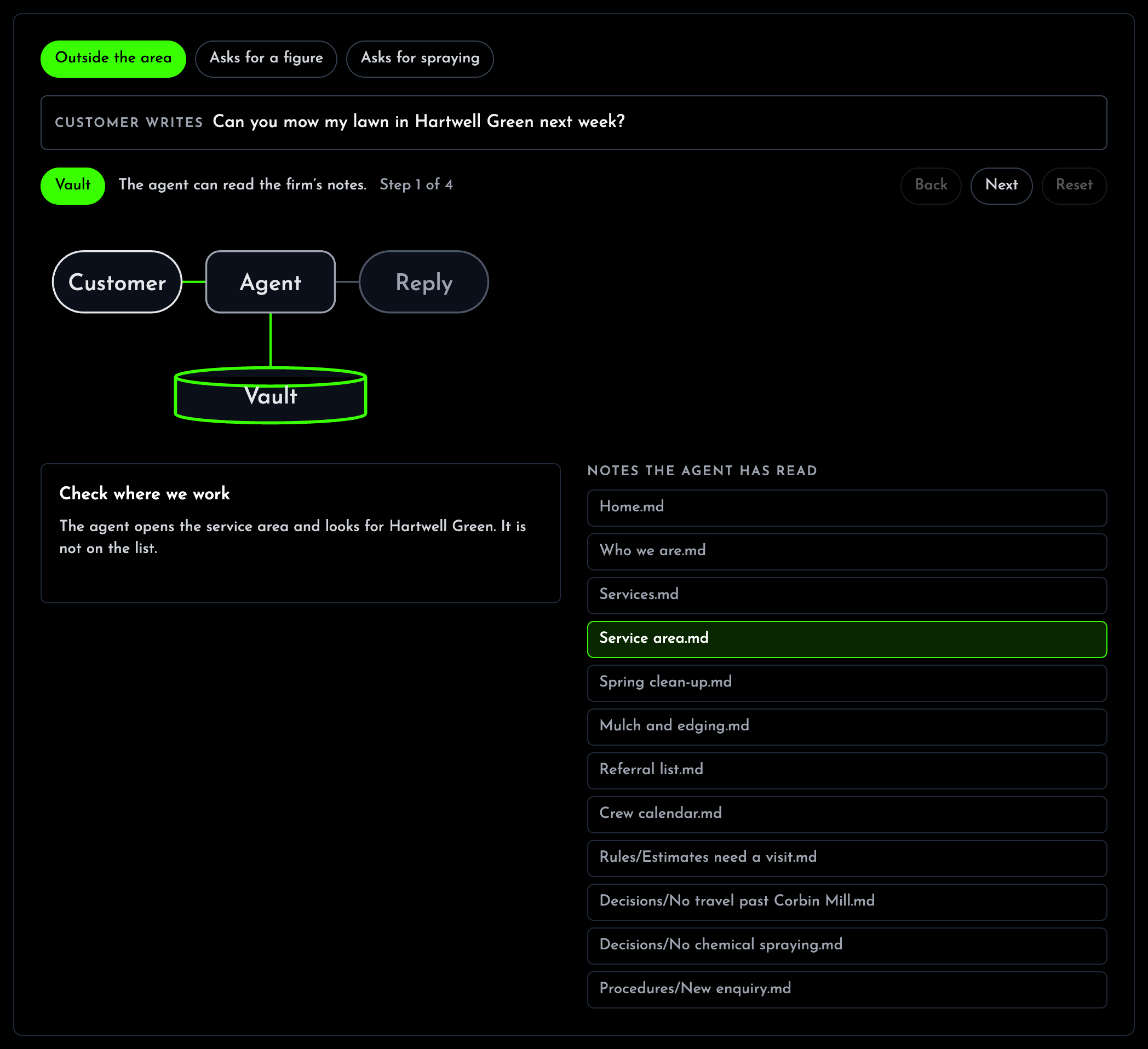
The same request with the vault on and off: the agent that read the notes first gives a different answer. The vault and the graph, chapter 2: read before you act.
So here’s how my two pieces connect. Isolated tasks are where the storm is: execution really has gotten cheap. Continuous work is where the gates are: without something holding the line between changes, the mistakes stack up. Go back to the Proton story as 404 Media reported it, with a counter on AI-written code, most review moving to AI, and staff who told 404 they feel unable to raise security concerns. A loop only gets better when a failed check is cheap to report. If 38 is anywhere near the right number, that’s the wrong place to be turning the dial down.
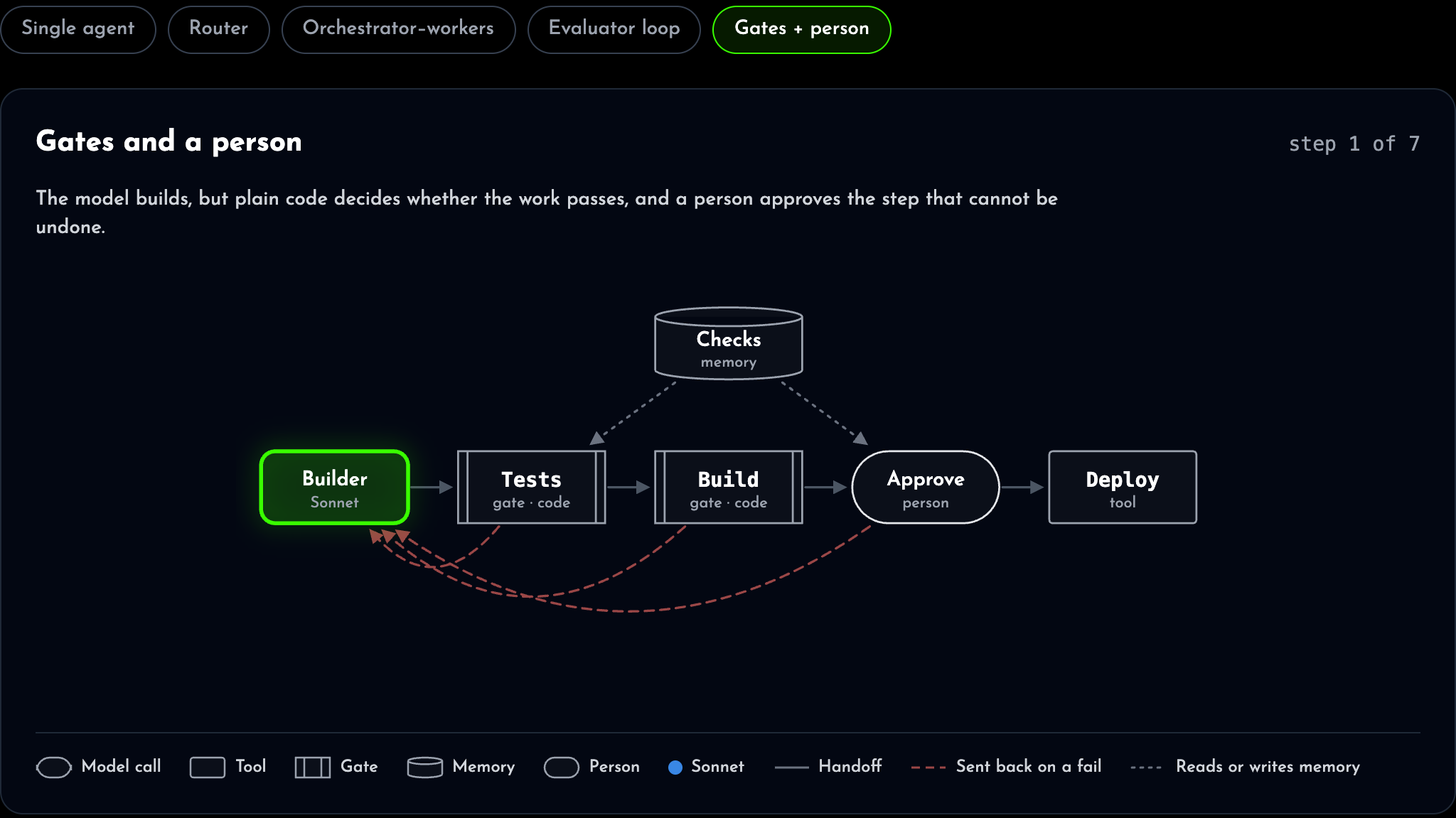
The model builds, plain code decides whether the work passes, and a person approves only the step that can’t be undone. Designing an agent graph, the “Gates + person” pattern.
Where I part ways with the paper
The paper’s table puts the LLM in the control center, and its last stage has agents modifying themselves with people setting goals and ethics from above. I don’t want that as the default, and it’s not what I build. I think the model should do the work and something deterministic should decide whether the work passes. A better model still shouldn’t grade its own homework.
I also don’t buy that capacity growing with compute gets you out of Brooks. The paper cites him on complexity. But his other point was coordination: the paths between workers grow much faster than the workers do, and I don’t see why that stops applying because the workers are agents.
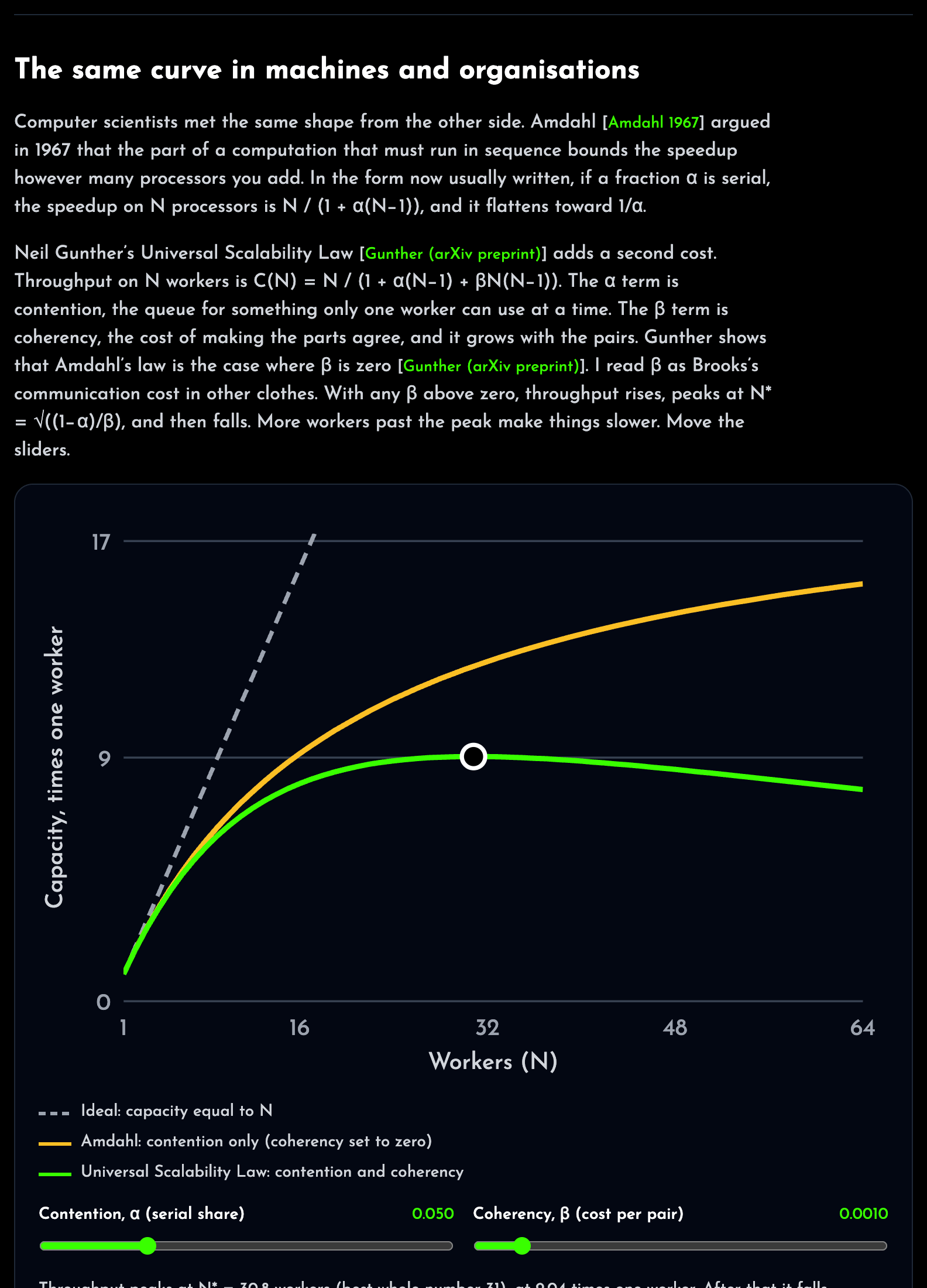
More workers, human or agent, peak and then slow a project down unless the work is cut into pieces that don’t need to talk. More people, more agents, same plan.
The evidence against me
I should turn this on myself. I said the SDLC would evaporate. A 38% score on continuous work is a real argument that it won’t, not soon, and that the people defending their pipelines have a point. I still read it as the process compressing into gates that run as code. But I don’t have evidence that gates close that gap. That’s my bet, from running these loops on my own sites, which is a long way from a benchmark. And this paper is one person’s preprint, with a formal-looking argument about complexity that I’d call a framing, not a proof.
I said last time that the line between conviction and psychosis is whether you still listen to the person telling you the check failed. Fair’s fair: this author changed the title in six days.
What I take from it
Software engineering isn’t over. Typing as the scarce skill is on its way out, and I still think that’s happening faster than most organizations can absorb. But the work that’s left is the part that was always hard: saying what you want, building the checks that tell you whether you got it, and keeping a system true over years rather than over one impressive demo.
The storm is real. The gates are how you stay on the board.
Read more:
Zhenfeng Cao, Agentic Software (arXiv preprint; v1 was “The End of Software Engineering”)
Deng et al., SWE-Milestone (ICML 2026; the benchmark, formerly EvoClaw)